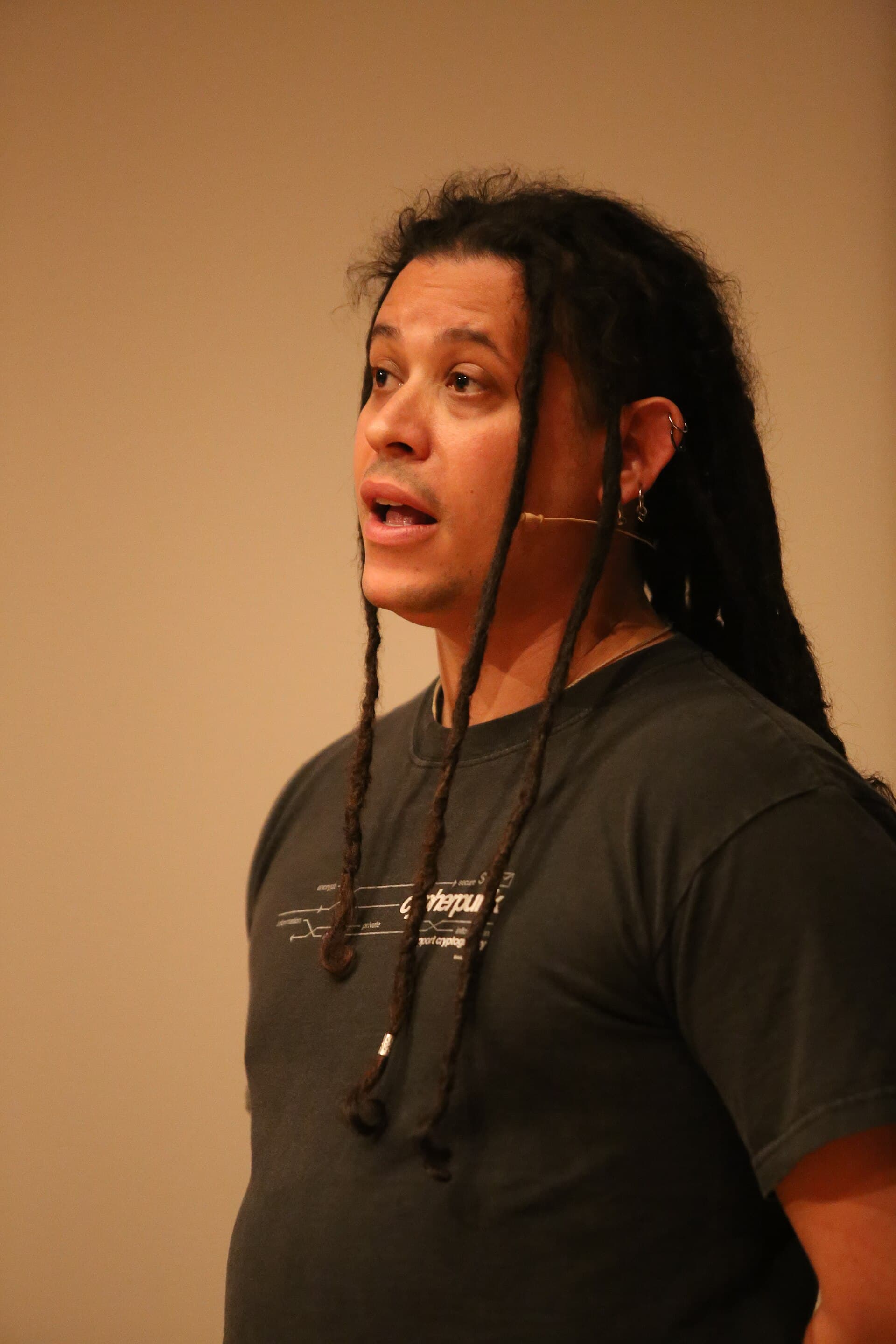
Morgan Marquis-Boire
New Zealand hacker, journalist, and security researcher
- Life
- 1980 – present
- Born
- 1980
- Nationality
- New Zealand
Morgan Marquis-Boire is a New Zealand-born hacker, journalist, and security researcher. Marquis-Boire previously served as an advisor to the Freedom of the Press Foundation. He was a Special Advisor to the Electronic Frontier Foundation (EFF) and advisor to the United Nations Interregional Crime and Justice Research Institute. He was the Director of Security at First Look Media and a contributing writer at The Intercept. He has been profiled by Wired, CNN, Süddeutsche Zeitung
Early Life
Marquis-Boire was born in New Zealand and began hacking as a teenager, operating under the handle headhntr. He later earned a bachelor's degree in political science from the University of Auckland.
Career
Marquis-Boire held a range of institutional roles in the digital security and press freedom communities. He served as Director of Security at First Look Media and as a contributing writer at The Intercept. He was a Special Advisor to the Electronic Frontier Foundation (EFF) and an advisor to both the Freedom of the Press Foundation and the United Nations Interregional Crime and Justice Research Institute. He also held a position as a senior researcher at Citizen Lab, the interdisciplinary research group based at the University of Toronto.
Internet Censorship Research
Marquis-Boire conducted significant research into Blue Coat Systems, a Palo Alto-based company providing internet blocking and monitoring solutions. His reports — including Planet Blue Coat: Mapping Global Censorship and Surveillance Tools (2013) and Some Devices Wander by Mistake: Planet Blue Coat Redux (2013) — received front-page coverage in the Washington Post and were also reported by the New York Times, the Globe and Mail, and the Jakarta Post. Following publication, Blue Coat announced it would cease providing support or services to software deployed in Syria. In April 2013, the US Bureau of Industry and Security imposed a fine of $2.8 million on an Emirati company that had exported Blue Coat filtering products to Syria without a license.
Surveillance Software Research
Marquis-Boire conducted extensive research into the global proliferation of commercial surveillance tools. In 2012, he and Bill Marczak provided the first public identification of FinFisher, a remote intrusion and surveillance suite developed by Munich-based Gamma International GmbH and marketed to law enforcement and intelligence agencies. Subsequent investigations revealed its use against Bahraini activists, documented variants targeting mobile operating systems, and uncovered spying campaigns against political dissidents in Malaysia and Ethiopia. The research identified FinFisher command-and-control servers in 36 countries and informed civil society responses in Pakistan, Mexico, and the United Kingdom.
Marquis-Boire and collaborators also investigated Hacking Team, a Milan-based company whose Remote Control System (RCS) software was mapped to network endpoints in 21 countries. Their findings included evidence of RCS being used against a human rights activist in the United Arab Emirates, a Moroccan media organization, and an Ethiopian diaspora news agency. These reports contributed to legal action by the EFF and Privacy International related to alleged surveillance of Ethiopian expatriates in the US and UK.
At the 23rd USENIX Security Symposium, Marquis-Boire co-authored the paper When Governments Hack Opponents: A Look at Actors and Technology, examining government targeting of activists, opposition members, and NGOs in Bahrain, Syria, and the United Arab Emirates.
Notable Work and Presentations
Marquis-Boire presented on targeted malware use during the Arab Spring at Black Hat Briefings in Las Vegas in 2012, covering surveillance campaigns in Libya, Syria, Bahrain, Morocco, and Iran. He co-authored a paper with Eva Galperin of the EFF on state-sponsored malware campaigns targeting the Vietnamese diaspora. With Shane Huntley, he co-authored a paper presented at Black Hat Singapore 2014 reporting that 21 of the world's top 25 media organizations had been targeted by state-sponsored hacking.
His work tracking the digital dimensions of the Syrian Civil War was featured in the book Black Code: Inside the Battle for Cyberspace and covered by BusinessWeek, the New York Times, Al Jazeera, and Wired. He appeared in the "State of Surveillance" episode of the HBO series Vice in May 2016, alongside Edward Snowden and Ron Wyden.
Marquis-Boire was named one of Wired Italy's Top 50 people of 2014 and was designated a Young Global Leader in March 2015.
Resignation and Allegations
In September 2017, Marquis-Boire resigned from his senior researcher position at Citizen Lab after the organization received an allegation of sexual assault at the 2014 Cyber Dialogue event. Citizen Lab subsequently cut all ties with him, and the EFF released a statement confirming he was no longer associated with the organization. In November 2017, The Verge published a report detailing specific claims of assault and rape from multiple individuals. A second article included alleged direct admissions by Marquis-Boire. The reporting identified at least ten women who alleged they had been sexually assaulted or raped by him.