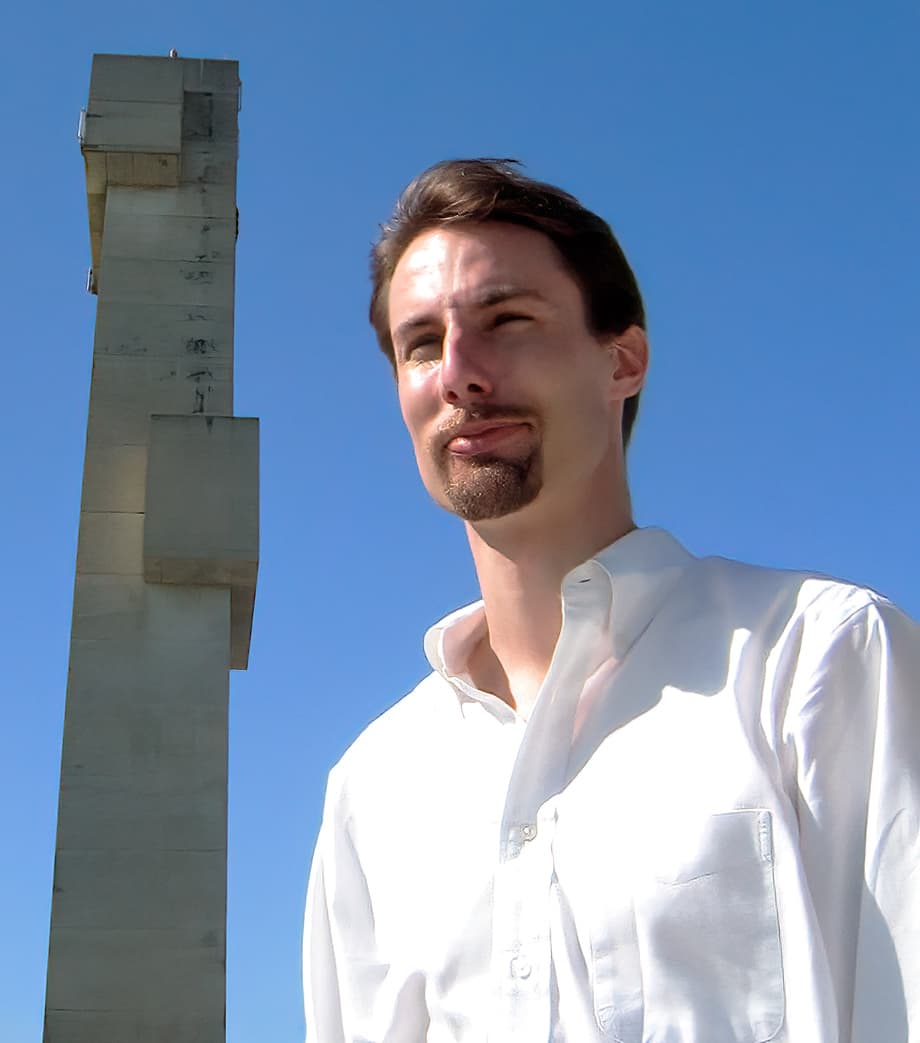
Bill Woodcock
Internet infrastructure pioneer (born 1971)
- Life
- 1971 – present
- Born
- August 16, 1971
- Nationality
- United States
William Edward Woodcock IV is the Secretary General of Packet Clearing House, the international organization responsible for providing operational support and security to critical Internet infrastructure, including Internet exchange points and the core of the domain name system; the chairman of the Foundation Council of Quad9; the president of WoodyNet; and the CEO of EcoTruc and EcoRace, companies developing electric vehicle technology for work and motorsport. Bill founded o
Early Life and Career Beginnings
William Edward Woodcock IV was born on August 16, 1971, in San Francisco, California. He entered the computer industry through desktop publishing, doing prepress work for the University of California Press when the Macintosh was released in 1984. He quickly transitioned into the nascent field of electronic prepress and, by 1985, was working with AppleTalk networks to connect Macintosh computers with digital imagesetters used in book production. By 1986, he was speaking at conferences on desktop publishing and electronic prepress.
Beginning in 1985, Woodcock volunteered with the Berkeley Macintosh Users Group (BMUG), providing technical assistance, contributing to its newsletters, and helping administer its FidoNet BBS. In 1989, he collaborated with BMUG Programming SIG chair Greg Dow to produce what may be the first instance of database publishing — a catalog of BMUG's shareware archive printed directly from a FileMaker database to film negatives on a Linotronic 300 PostScript imagesetter.
Woodcock studied Book Arts at the UC Santa Cruz Cowell Press under George Kane and contributed illustrations to the book Networking the Macintosh. He was also one of the founders of Netsurfer Digest, widely regarded as the first online periodical about the World Wide Web, and served as its production manager from 1994 through 2005.
Early Internet Engineering
In 1987, Woodcock began building Zocalo, an Internet backbone network with roots in a small office network he had constructed while working at Farallon Computing in the mid-1980s. When the network expanded from Berkeley to Santa Cruz in 1989, he began using anycast routing to distribute traffic between servers in the two locations — an early, practical deployment of a technique that would become ubiquitous in Internet infrastructure.
Throughout the 1990s, Woodcock continued developing IP anycast load-balancing techniques. Together with Mark Kosters, he proposed at the 1996 Montreal IEPG meeting that the root DNS servers be migrated to IP anycast, work that has informed root DNS server deployment ever since. In the early 2000s, he developed the "Prefix-List Sanity Checker" toolset, widely used by major Internet networks to validate BGP routing announcements during the period between the RPSL and RPKI eras.
In 2010 and 2011, working with Rick Lamb, Woodcock built the first global-scale FIPS 140-2 Level 4 DNSSEC signing infrastructure, with locations in Singapore, Zurich, and San Jose. He has also developed networking products for Cisco, Agilent, and Farallon.
Cybersecurity and Critical Infrastructure
In 2001, Woodcock, together with Sean Donelan and John Todd, constructed the INOC-DBA (Inter-Network Operations Center Dial-By-Autonomous-System-Number) hotline system, which at its peak interconnected more than 2,800 NOCs and CERTs. It was notably the first inter-carrier SIP VoIP network and the first telephone network to provide service on all seven continents.
In 2007, Woodcock served as one of two international liaisons in Estonia, assisting CERT-EE during Russia's cyberattacks on the country by coordinating international efforts to intercept and block inbound attack traffic. During Russia's 2008 cyber-attack on Georgia, he was widely quoted as an analyst of nation-state cyber warfare.
In 2017, Woodcock was appointed to the Global Commission on the Stability of Cyberspace, serving until its conclusion in 2019 and participating in drafting its eight norms related to non-aggression in cyberspace. Following the Caribbean hurricanes of 2017, he helped establish the Commission on Caribbean Communications Resilience and assisted in drafting its final recommendations.
Policy and Advocacy
In 1997 and 1998, Woodcock and J. D. Falk worked with the California legislature to enact what is considered the world's first anti-spam legislation, California Assembly Bill 1629, which later served as a basis for U.S. federal anti-spam law.
In 2019 and 2020, Woodcock organized the successful opposition to the proposed $1.1 billion sale of the .ORG top-level domain to private equity firm Ethos Capital. In March 2022, he was a lead author of the open letter Multistakeholder Imposition of Internet Sanctions, addressing principles for Internet-related sanctions in the context of Russia's invasion of Ukraine.
His advocacy on telecommunications competition and Internet exchange policy has informed OECD best-practice recommendations to member countries. In 2011, he produced the first-ever survey of peering connections between Internet networks, characterizing more than 142,000 such agreements, followed by a second survey covering 1.9 million connections in 2016.
Current Roles
Woodcock serves as Secretary General of Packet Clearing House, a position he has held since 2001, and as Chairman of the Foundation Council of Quad9. He is also president of WoodyNet and CEO of EcoTruc and EcoRace, companies developing electric vehicle technology for commercial and motorsport applications.
§Related entries
Charlie Miller (security researcher)
American computer security researcher
1971 – present · United States
Chris Krebs
American cybersecurity and infrastructure security expert (born 1977)
1977 – present · United States

David Venable
Cyber security professional (born 1978)
1978 – present · United States
Joe Grand
American electrical engineer
1975 – present · United States
Kathy Warden
American business executive
1975 – present · United States
Mark Abene
American InfoSec expert and former hacker (born 1972)
1972 – present · United States