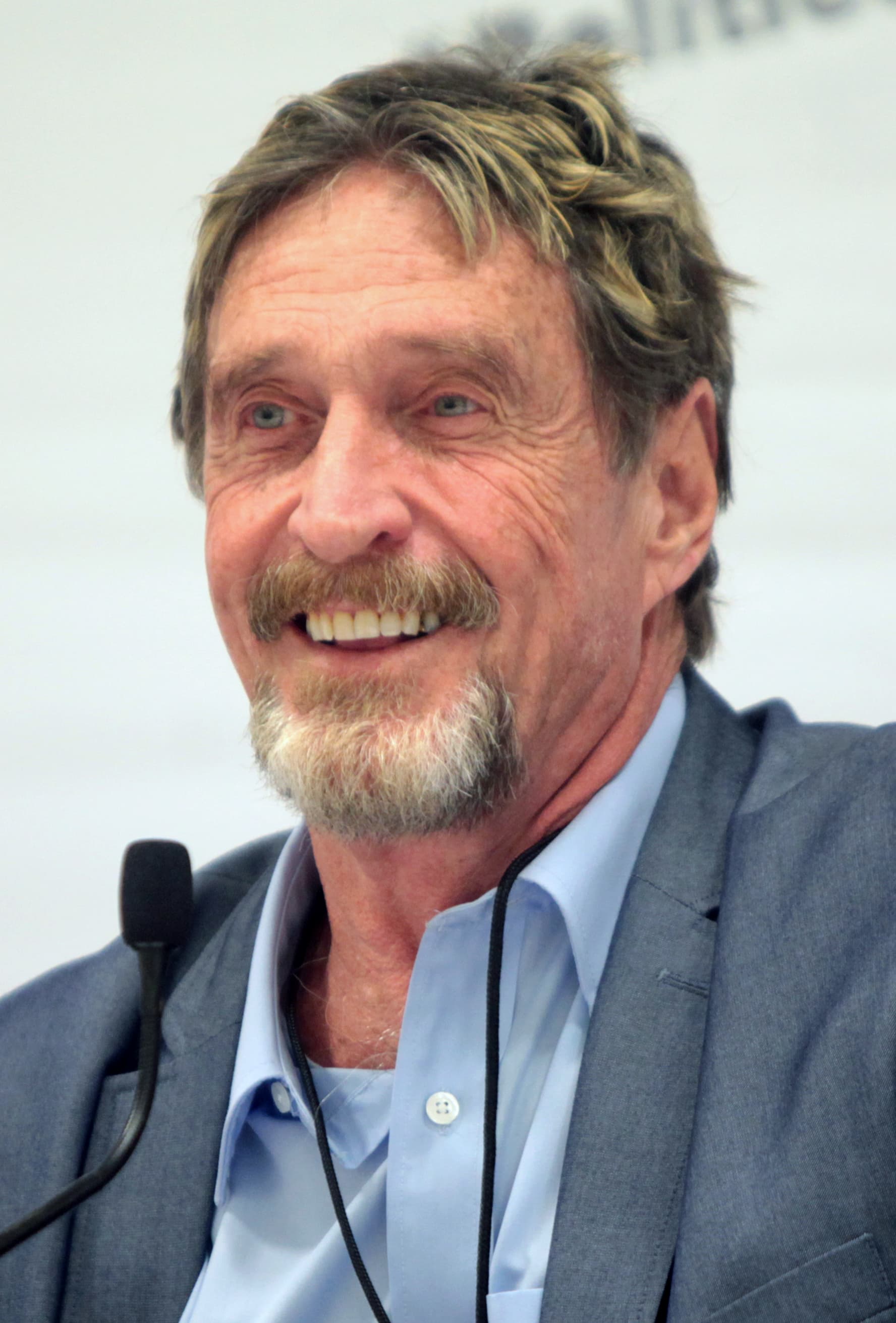
John McAfee
British and American programmer and businessman (1945–2021)
- Life
- 1945 – 2021
- Born
- September 18, 1945
- Died
- June 23, 2021
- Nationality
- United States, United Kingdom
John David McAfee was a British and American computer programmer, businessman, and two-time U.S. presidential candidate who unsuccessfully sought the Libertarian Party nomination for president of the United States in 2016 and in 2020. In 1987, he wrote the first commercial anti-virus software, founding McAfee Associates to sell his creation. He resigned in 1994 and sold his remaining stake in the company. McAfee became the company's most vocal critic in later years, urging co
Early Life
John David McAfee was born on 18 September 1945 in Cinderford, in the Forest of Dean, Gloucestershire, England, on a U.S. Army base belonging to the 596th Ordnance Ammunition Company. His father, Don McAfee, was an American soldier from Roanoke, Virginia; his mother, Joan Williams, was British. McAfee was primarily raised in Salem, Virginia, and later said he felt as much British as American. His childhood was marked by a difficult home life; a BBC columnist described his father as "an abusive alcoholic." His father died by suicide with a gun when McAfee was 15.
McAfee earned a bachelor's degree in mathematics in 1967 from Roanoke College in Virginia, which later awarded him an honorary Doctor of Science degree in 2008. He subsequently began doctoral studies in mathematics at Northeast Louisiana State College but was expelled around 1968 following a relationship with an undergraduate student, who became his first wife.
Career
Early Employment
McAfee worked as a programmer at NASA from 1968 to 1970, then moved to Univac as a software designer and later to Xerox as an operating system architect. In 1978 he joined Computer Sciences Corporation as a software consultant, and from 1980 to 1982 he worked for consulting firm Booz Allen Hamilton. By 1986 he was employed at Lockheed, where he encountered a description of the Brain computer virus for the PC. Recognizing both the threat and a commercial opportunity, he set about developing software capable of detecting and automatically removing such viruses.
McAfee Associates and VirusScan
In 1987, McAfee founded McAfee Associates Inc. and released VirusScan, widely credited as the first antivirus software brought to market and among the first software products distributed over the internet. Rather than immediately pursuing a large base of paying customers, McAfee initially focused on raising public awareness of the threat posed by computer viruses. By 1990, the company was generating $5 million per year. McAfee Associates was incorporated in Delaware in 1992 and held its initial public offering that same year. In August 1993, McAfee stepped down as chief executive, transitioning to the role of chief technical officer; he was succeeded as CEO by Bill Larson. He sold his remaining stake in the company in 1994 and had no further operational involvement.
Intel acquired McAfee in August 2010. In January 2014, Intel announced that McAfee-branded products would be marketed under the Intel Security name. McAfee publicly welcomed the rebrand. The business was subsequently de-merged from Intel and returned to the McAfee name. In his later years, McAfee became one of the company's most vocal critics, urging consumers to uninstall its software, which he characterized as bloatware, and disavowing the continued use of his name in its branding.
Subsequent Ventures
Following his departure from McAfee Associates, he founded Tribal Voice in 1994, which developed PowWow, one of the first instant messaging programs. In 2000 he joined the board of Zone Labs, makers of firewall software, prior to its acquisition by Check Point Software in 2003. That same year he purchased a large property in Colorado and opened a yoga and meditation retreat, subsequently authoring four books on yoga and meditation.
The 2008 financial crisis significantly reduced his personal fortune, which fell from a reported peak of $100 million to approximately $4 million according to a 2009 New York Times report. McAfee relocated to Belize in 2009, acquiring beachfront property on Ambergris Caye. In February 2010, he co-founded QuorumEx in Belize, a company aimed at developing herbal antibiotics that disrupt quorum sensing in bacteria.
In 2013, McAfee founded Future Tense Central, which sought to produce a secure networking device called the D-Central. In May 2016, he was appointed chairman and CEO of MGT Capital Investments, a technology holding company, where he pivoted the firm's focus toward cybersecurity. Products developed under his leadership included Sentinel, a hardware-based network intrusion detection tool, and E-tagged, a device for tracking mobile phones via passive wireless signal monitoring. He stepped down as CEO in August 2017 and left MGT entirely in January 2018. In August 2018, he became CEO of Luxcore, a cryptocurrency-focused enterprise company.
Notable Work and Public Positions
McAfee was a prominent and outspoken advocate for privacy, personal freedom, and cryptocurrency. He opposed government surveillance and framed cryptocurrency as a mechanism for reducing state control over financial systems. He made widely publicized predictions about bitcoin's price trajectory and in 2016 publicly offered to decrypt the iPhone associated with the San Bernardino attack, later acknowledging the offer was partly a publicity stunt.
At the DEF CON conference in August 2014, he warned consumers about the surveillance risks posed by smartphone applications. He also served as chief evangelist for security startup Everykey beginning in January 2016.
Politics
McAfee sought the Libertarian Party presidential nomination twice. He announced his first campaign in September 2015, initially under a newly formed Cyber Party banner before switching to the Libertarian Party. He participated in the party's first nationally televised presidential debate on 29 March 2016 alongside Gary Johnson and Austin Petersen, finished second in the primaries, and placed third at the 2016 Libertarian National Convention. His running mate was Libertarian activist Judd Weiss.
He announced a second presidential run in June 2018, again seeking the Libertarian nomination, with cryptocurrency advocacy as a central theme. His 2020 campaign was conducted largely from abroad amid reported tax-related indictments. He did not secure the nomination at the 2020 Libertarian National Convention.
Legal Issues and Death
McAfee faced a series of legal difficulties across multiple jurisdictions. In November 2012, Belize police sought him as a person of interest in the homicide investigation of his neighbor Gregory Viant Faull; McAfee fled Belize rather than cooperate with investigators and was never charged in connection with the case. He was arrested in Tennessee in August 2015 on charges of driving under the influence and possession of a firearm while intoxicated. In July 2019, he and members of his entourage were detained in the Dominican Republic on suspicion of carrying high-caliber weapons.
In October 2020, McAfee was arrested in Spain on U.S. tax evasion charges. Federal prosecutors alleged he had failed to file income tax returns over a four-year period. On 23 June 2021, he was found dead in his prison cell near Barcelona, shortly after the Spanish National Court authorized his extradition to the United States. Authorities attributed his death to an apparent suicide by hanging. His wife, Janice McAfee, stated she did not believe he died by suicide. His death prompted widespread speculation about the circumstances.