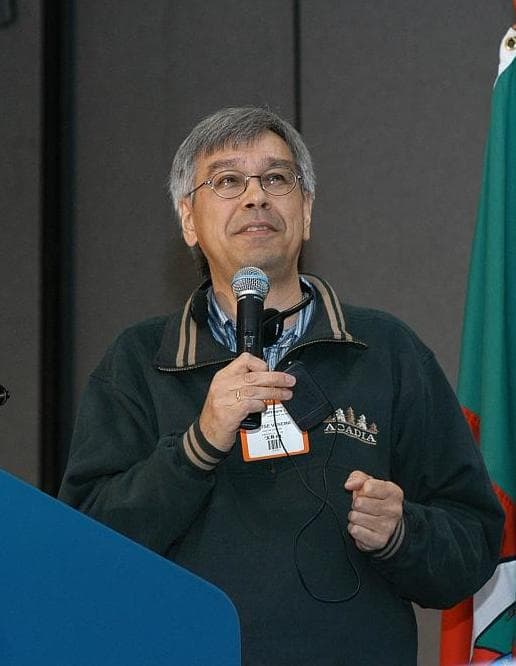
Wietse Venema
American computer scientist (born 1951)
- Vie
- 1951 – présent
- Né(e) le
- 1951
Wietse Zweitze Venema is a Dutch programmer and physicist best known for writing the Postfix email system. He also wrote TCP Wrapper and collaborated with Dan Farmer to produce the computer security tools SATAN and The Coroner's Toolkit.
Early Life and Education
Wietse Zweitze Venema was born in 1951 in the Netherlands. He pursued an academic path in physics, studying at the University of Groningen, where he went on to earn a PhD in 1984. His doctoral dissertation, Left-right symmetry in nuclear beta decay, reflected a rigorous scientific foundation that would later inform his methodical approach to software engineering and computer security.
Academic and Early Professional Career
Following his doctorate, Venema spent twelve years at Eindhoven University of Technology as a systems architect within the Mathematics and Computer Science department. During this period he worked on tools related to Electronic Data Interchange, gaining deep practical experience in networked systems and infrastructure. It was also during this era that he began producing the security and systems software that would establish his reputation in the global computing community.
Security Tools and Notable Work
Venema is credited with writing TCP Wrapper, a host-based network access control utility that became a standard component of Unix and Linux systems, allowing administrators to monitor and filter incoming network traffic at the service level.
In collaboration with security researcher Dan Farmer, Venema developed SATAN (Security Administrator Tool for Analyzing Networks), a landmark network vulnerability scanner released in the mid-1990s. SATAN was notable for making automated security auditing accessible to system administrators, and its release generated significant discussion about the dual-use nature of security tools.
Venema and Farmer also collaborated on The Coroner's Toolkit, a suite of forensic utilities designed to assist investigators in analyzing Unix systems following a security incident. The toolkit contributed foundational concepts and practical methods to the emerging discipline of digital forensics.
His most widely deployed creation is Postfix, a mail transfer agent designed as a secure, fast, and easy-to-administer alternative to Sendmail. Postfix became one of the dominant email server solutions on the internet, adopted by organizations and service providers worldwide. Its architecture emphasized security through modularity and privilege separation, reflecting Venema's broader philosophy toward systems design.
Industry Career
Venema emigrated to the United States in 1996 and joined the IBM Thomas J. Watson Research Center in New York State, where he continued his work in security and systems research for nearly two decades. On March 24, 2015, he publicly announced his departure from IBM to join Google.
Recognition
Venema's contributions to open-source software and computer security have been recognized with a number of awards over the years:
- Security Summit Hall of Fame Award (July 1998)
- SAGE Outstanding Achievement Award (November 1999)
- NLUUG Award (November 2000)
- Sendmail Milter Innovation Award (November 2006)
- Free Software Foundation Award for the Advancement of Free Software (March 2009)
- ISSA Hall of Fame Award (October 2012)
Legacy
Venema's body of work spans foundational internet infrastructure, network security tooling, and digital forensics. Postfix alone has had a lasting impact on how email is delivered across the internet, while TCP Wrapper, SATAN, and The Coroner's Toolkit each contributed meaningfully to the practice of systems security administration and incident response. His career represents a sustained intersection of academic rigor and practical open-source contribution.
§Entrées associées

Ben Laurie
Ben Laurie est un ingénieur logiciel anglais, surtout connu pour avoir créé Apache-SSL et co-développé Certificate Transparency.
1953 – présent

Clifford Stoll
American astronomer, author and teacher (born 1950)
1950 – 2024 · États-Unis

Eric Corley
Hacker américain
1959 – présent · États-Unis