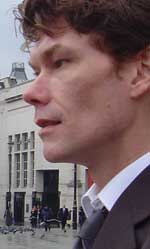
Gary McKinnon
Scottish computer hacker (born 1966)
- Life
- 1966 – present
- Born
- February 1966
- Nationality
- United Kingdom
Gary McKinnon is a Scottish systems administrator and hacker who was accused by a US prosecutor in 2002 of perpetrating the "biggest military computer hack of all time". McKinnon said that he was looking for evidence of free energy suppression and a cover-up of UFO activity and other technologies potentially useful to the public. On 16 October 2012, after a series of legal proceedings in Britain, then Home Secretary Theresa May blocked extradition to the United States.
Early Life
Gary McKinnon was born in February 1966 in Glasgow, Scotland. His interest in computers began at the age of 14, when he received an Atari 400 console — an introduction that would shape the trajectory of his adult life.
The Alleged Intrusions
Between February 2001 and March 2002, US authorities accused McKinnon of hacking into 97 United States military and NASA computers over a 13-month period, operating from his girlfriend's aunt's house in London under the online handle 'Solo.' The US government alleged that he deleted critical files from operating systems, shutting down the US Army's Military District of Washington network of 2,000 computers for 24 hours. He was also alleged to have posted a message on a military website reading "Your security is crap."
Following the September 11, 2001 attacks, McKinnon allegedly deleted weapons logs at the Earle Naval Weapons Station, rendering a network of 300 computers inoperable and disrupting munitions supply deliveries for the US Navy's Atlantic Fleet. US authorities estimated the cost of tracking and correcting the damage at over $700,000. McKinnon was additionally accused of copying data, account files, and passwords onto his own computer.
McKinnon publicly admitted to gaining unauthorized access to US computer systems but framed his motivation as a search for evidence of UFO activity, antigravity technology, and suppressed free energy research. He cited the Disclosure Project — whose statement before the Washington Press Club on 9 May 2001 he described as a key influence — as the basis for his belief that such information existed within government systems. He claimed to have investigated reports that NASA's Johnson Space Center was digitally altering photographic images to remove evidence of unidentified craft, and stated he viewed an image of an unidentified cigar-shaped object above the northern hemisphere before his connection was interrupted.
Arrest and Legal Proceedings
McKinnon was first interviewed by UK police on 19 March 2002 at the request of the United States, and again on 8 August 2002 by the UK National Hi-Tech Crime Unit. In November 2002, a federal grand jury in the Eastern District of Virginia indicted him on seven counts of computer-related crime, each carrying a potential ten-year sentence — a combined maximum exposure of 70 years imprisonment.
He remained at liberty without restriction for three years until June 2005, when bail conditions required him to sign in at a local police station each evening and remain at his home address at night. The passage of the UK Extradition Act 2003 had by then altered the legal landscape, allowing the United States to seek extradition without providing contestable prima facie evidence.
Extradition Battle
McKinnon pursued multiple avenues of appeal against extradition. In June 2008, his barristers argued before the House of Lords that US prosecutorial pressure — offering 37–46 months if he cooperated versus 8–10 years per count if he contested — constituted an abuse of process incompatible with English legal principles. The House of Lords rejected this argument. McKinnon subsequently appealed to the European Court of Human Rights, which briefly imposed a bar on extradition, and later sought judicial review in the High Court, losing that appeal in July 2009. In August 2009, then-Prime Minister Gordon Brown attempted to negotiate a deal allowing McKinnon to serve any US sentence in the UK; the US government declined.
In January 2010, Mr Justice Mitting granted a further judicial review, centering on psychiatric evidence that McKinnon would certainly attempt suicide if extradited, and whether this created an obligation under the Human Rights Act 1998 to refuse extradition.
Extradition Blocked
On 16 October 2012, Home Secretary Theresa May announced to the House of Commons that extradition had been blocked, citing McKinnon's diagnosis of Asperger's syndrome and depressive illness, and concluding that the risk to his life made extradition incompatible with his human rights. The Director of Public Prosecutions subsequently determined that McKinnon would not face trial in the United Kingdom either, citing difficulties in mounting a successful prosecution and the likelihood of acquittal.
Public Support
McKinnon attracted substantial public support throughout his legal ordeal. Eighty British MPs signed an Early Day Motion on his behalf in 2008. Prominent figures including David Gilmour, Bob Geldof, Chrissie Hynde, Peter Gabriel, Sting, Stephen Fry, and Boris Johnson publicly advocated for him to be tried in the UK. In August 2009, David Gilmour released an online single, "Chicago - Change the World," featuring Hynde, Geldof, and McKinnon himself, to raise awareness of the case. McKinnon's mother, Janis Sharp, stood as an independent candidate in the 2010 general election in Blackburn in protest against the extradition treaty, finishing last among eight candidates.